40 year anniversary
It was a year of celebration in 1945. Not only was the Second World War over, but it was also the year that Rolex celebrated 40 years in its current form: independent, innovative and firmly established in the world of wristwatches. This anniversary was therefore celebrated in a significant way, at the luxurious Hotel des Bergues on Lake Geneva.
Here, Rolex presented an extraordinary collection in which existing models were renewed and completely new models were introduced. Alongside an impressive collection of jewellery watches, there were also several pocket watches and a large selection of small ladies’ models. The division between men’s and ladies’ watches was approximately 50/50.
Of course, one of the most important models was the Rolex Oyster Perpetual “Datejust”, with its date indication and flexible metal bracelet. This bracelet would become the third iconic bracelet of the brand, after the President and Oyster: the “Jubilé” bracelet, named after the anniversary.
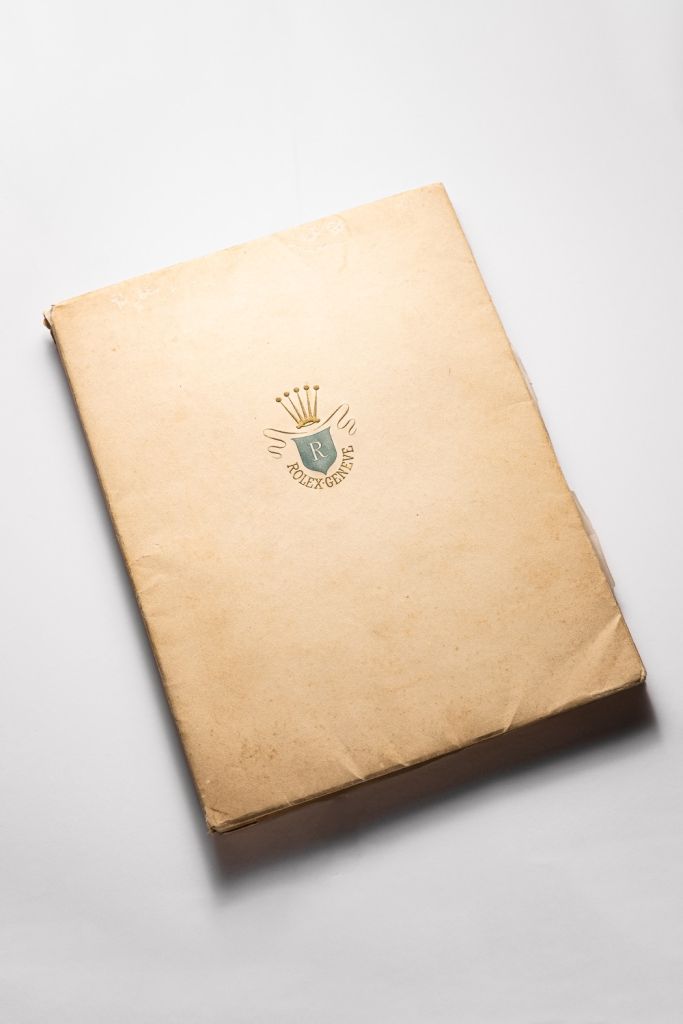
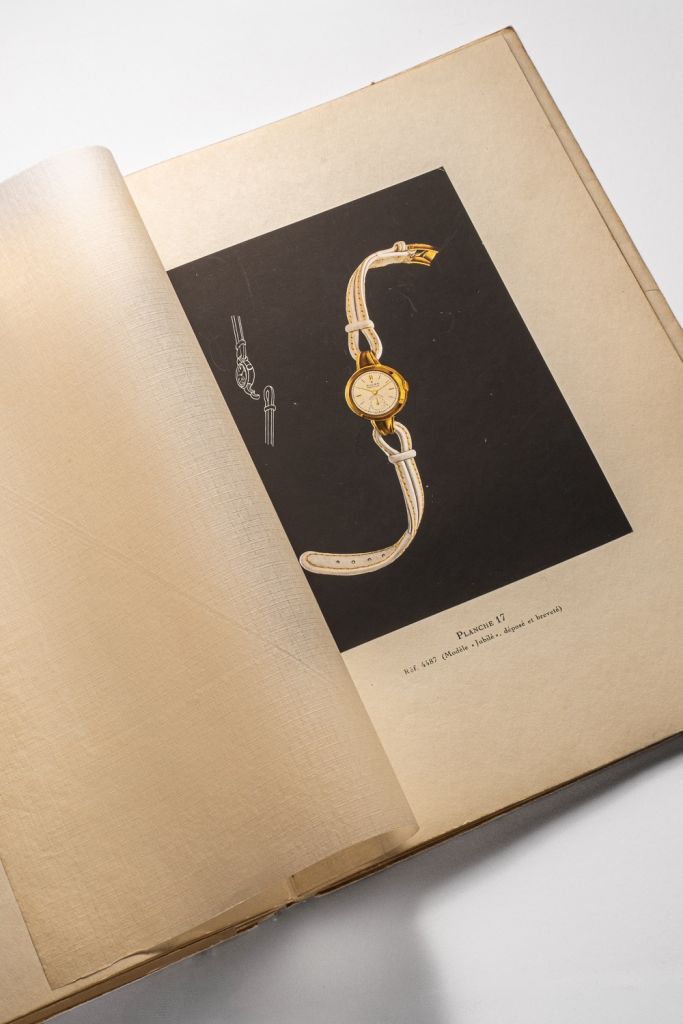
In the limited-edition booklet ROLEX JUBILÉ 1905–1920–1945, the models were printed in colour and carefully protected with photographic paper. The booklet consists of 26 “planches”, each showing a full-page image with the corresponding reference number. Some of the models are marked “Modèle Déposé”.
On page 25 we find the first known Rolex Oyster Perpetual “Datejust”, reference 4467. At the bottom of the page it states: “Model – Jubilé – Déposé”. This was a model specially introduced for the occasion, with the model and its innovation registered.
It is a model that still makes many a watch collector’s heart beat faster. For many collectors, this is where their interest in Rolex started, and the term “Jubilee” has become part of the vocabulary of the wider watch community.
The 4467 is a men’s Rolex watch in an Oyster case measuring 36mm in diameter. It is water resistant and has an automatic movement and a date indication, which was a remarkable combination at the time. It was a model that was given the special designation “Jubilé”. In the entire booklet, it is the only Oyster model to receive this designation. But there is more to the story…
Don’t forget the ladies
When looking through old Rolex catalogues, it immediately becomes clear that ladies’ models represented a significant part of the collection. During the 1950s and 1960s, the ratio was approximately 60/40, with ladies’ watches making up around 60 percent.
A brand that today is mainly associated with male collectors and is known for its sporty models was therefore once much more focused on the production and sale of ladies’ watches.
It was only after the introduction of the Submariner, GMT-Master and Cosmograph in the early 1960s that the focus gradually shifted towards men’s watches. Rolex continued to produce a substantial collection of ladies’ watches, but fashion changed. Women began wearing larger watches, and men naturally did not want to be left behind. As a result, the average watch size gradually moved towards what had traditionally been considered a men’s size.
Interest for small watches is coming
Fortunately, there is now another trend developing. Men are once again wearing watches that fit their wrists better rather than simply following the size dictated by fashion. Sizes such as 34 and 35mm are becoming increasingly accepted for men, especially with classic three-hand watches. There are even trendsetters who are quite happy to wear a classic ladies’ model on a man’s wrist.
With more than 25 years of experience in the watch world, I have seen many changes and fashion trends. Who knows what will change next when it comes to the size of wristwatches?
In 1945, however, Rolex had already decided that there should be a Jubilee model for both men and women.Just as the men’s Rolex Oyster Perpetual, reference 4467, was a unique model for the anniversary, there was also a unique ladies’ model: reference 4487.
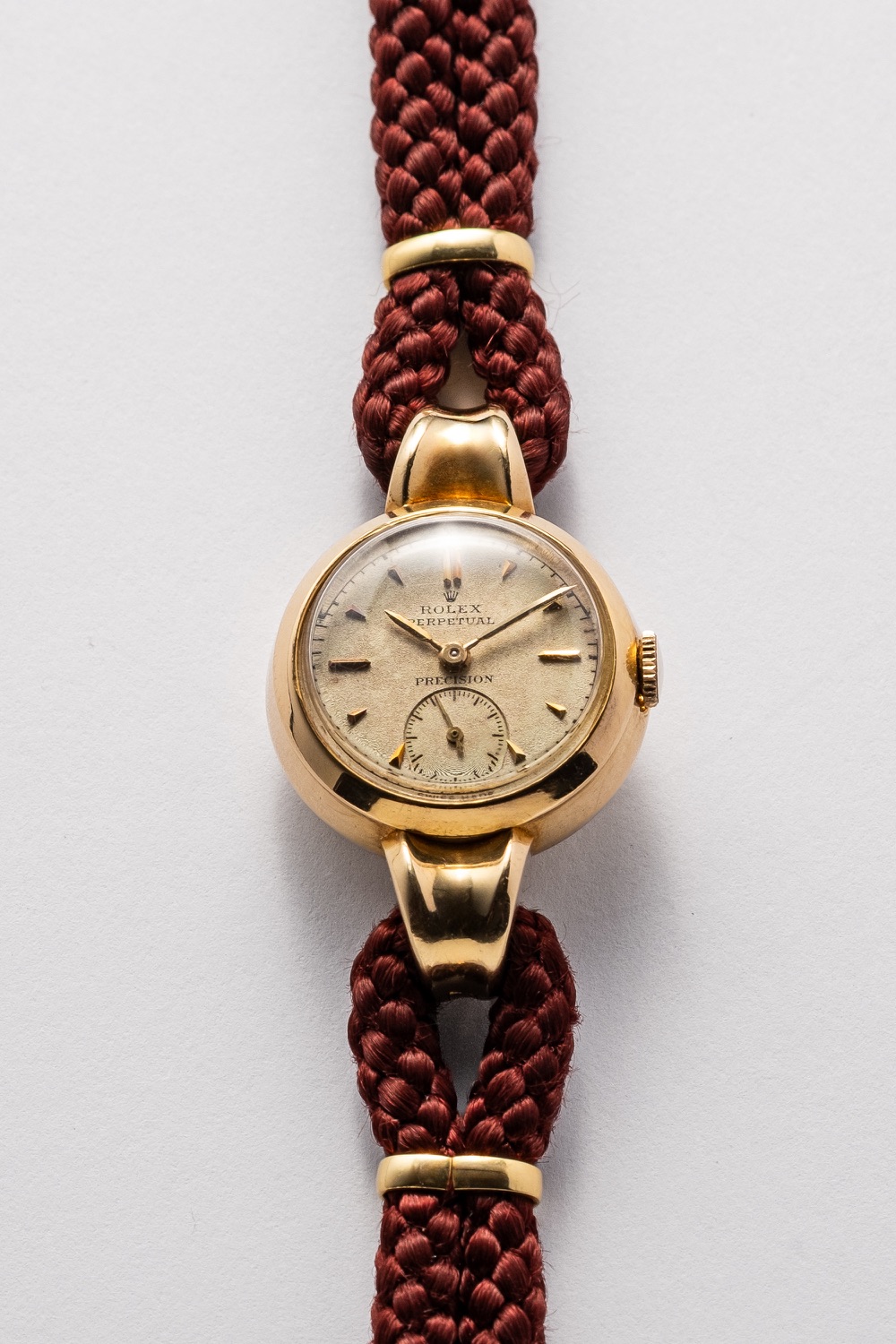
So there were two Jubilee models introduced for the 40th anniversary of Rolex. The reference 4487 is a small gold ladies’ watch with a very unusual feature. At the time, it contained the smallest automatic Rolex Perpetual movement, but the wearer could also change the bracelet very easily.
In image 17 of ROLEX JUBILÉ 1905–1920–1945, the ladies’ reference 4487 is shown with the designation “Model – Jubilé – Déposé et Breveté”.
This means that the model was not only created specifically for the anniversary, but that the design was also deposited and the system was patented as an innovation developed by Rolex.
It was a fashionable model in the 1940s, when ladies often wore watches on what was known as a cord bracelet. A cord passed through the case of the watch and formed the bracelet. It was held together by a small gold ring and often combined with a gold folding clasp or branded bracelet system to secure the ends.
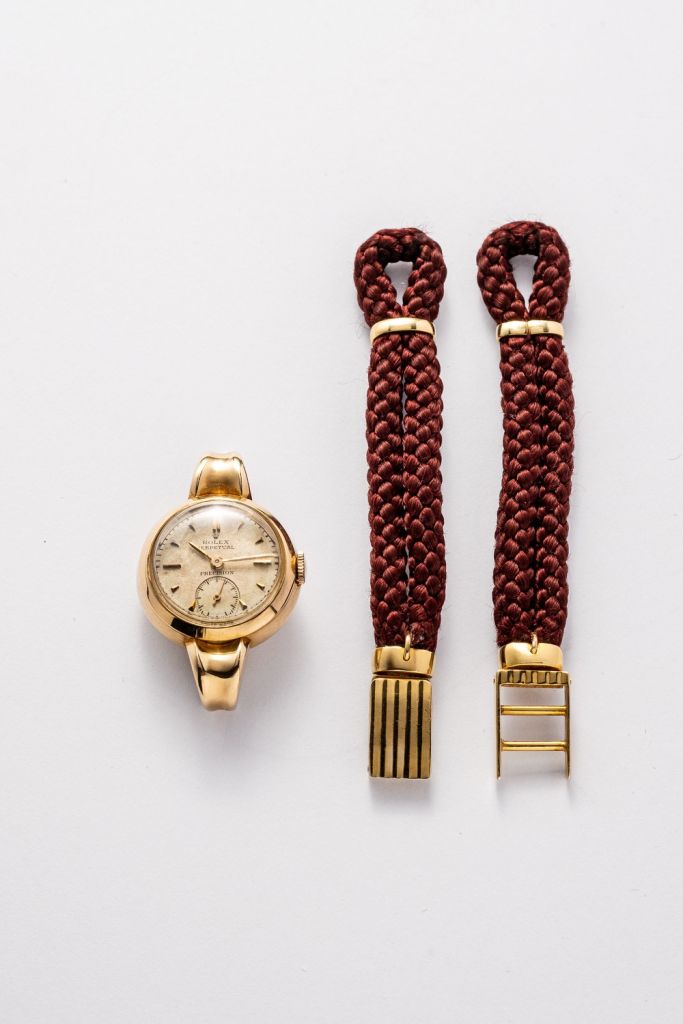
Changing such a bracelet was a time-consuming and difficult job compared with changing a traditional leather strap. It normally had to be done by a watchmaker or jeweller. Rolex had found a solution.The opening through which the bracelet passed could be easily opened and closed, allowing the bracelet to be changed.
According to the contemporary advertisement:
One novel feature will appeal particularly to the well-dressed woman: the Jubilee Watch is provided with two leather straps and one silk cord bracelet. A patented clasp, specially created for this model, allows the bracelet to be adapted simply and quickly to match the clothes.
ROLEX – Perpetual De Luxe, The jubilee watch for ladies.
The watch
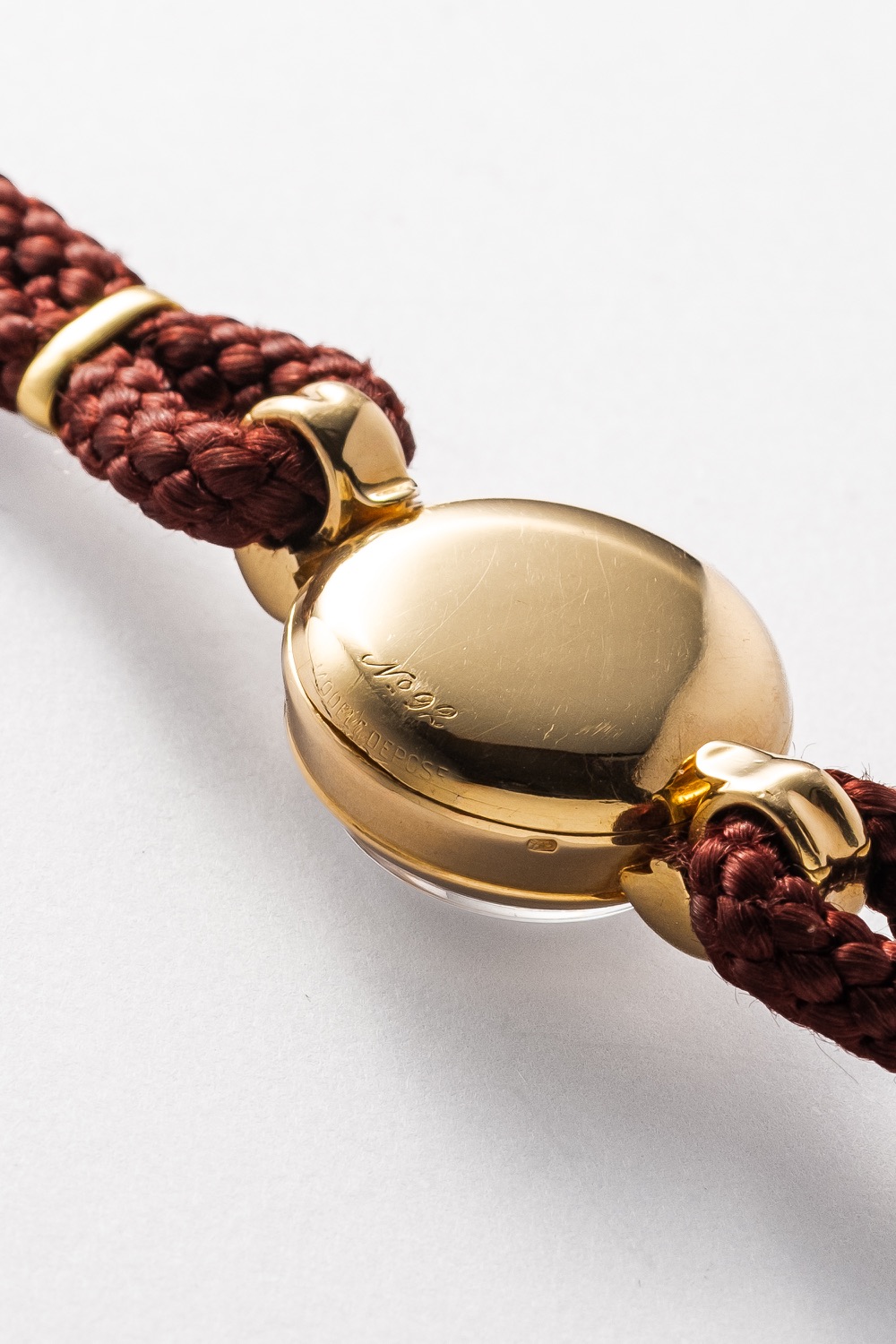
Both the first Rolex Datejust, reference 4467, and the ladies’ Rolex De Luxe, reference 4487, have an individual number. This number was hand engraved. This would make them some of the earliest and also very rare limited editions produced by Rolex. The exact number produced is not known, but most experts agree that there were probably no more than 100 examples of each model.
To my knowledge, no example with an individual number higher than 100 has been found. The example we have found and offered is number 92.
The watch itself is elegant but also quite substantial at the same time. Inside is the automatic Rolex Cal. 420. At the time, this was the smallest Rolex Perpetual movement and it was based on the Rolex Cal. 400. The movement measures only 7 3/4 lignes. Because of its small diameter and the position of the rotor, the movement is almost as thick as it is wide.
The case has a diameter of approximately 22mm. Including the lug attachment, the total length is around 37mm. With a thickness of approximately 12mm, it is a very compact watch. The case is made of 18k gold and carries Swiss hallmarks. It was made by case maker number 12, referring to Genex SA in Chêne-Bourg, registered in 1934 and discontinued in 1985. According to the case number, this fits within the 1945 anniversary period.
The watch remains in good condition and the clasp system still works very well. Considering its age, the case and dial are in original condition. The hands are also original inclusive the small second one.
For the Rolex collector, the reference 4487 offers a rare opportunity to own a small but significant part of the brand’s history. It represents the lesser-known ladies’ side of the 1945 Jubilee story and stands alongside the famous reference 4467 as one of the two models created to mark Rolex’s 40th anniversary.
It is a watch that deserves to be appreciated not only for its rarity, but also for the story it tells about Rolex, its approach to design and innovation, and the important place ladies’ watches once held within the brand’s collection.
For those who appreciate vintage watches, man and woman, originality and the history behind them, the reference 4487 is a particularly interesting and unusual Rolex. A small watch, with a remarkable place in Rolex history — and perhaps one of the most overlooked Jubilee models ever made.
Source for case maker information: vintagewatchstraps.com