The Explorer
Loved by many watch enthusiasts and a true icon within the Rolex family, the Explorer is one of those watches that really needs little introduction. If you have already landed on this page, I probably don’t need to explain the origins and history of the model to you.
The story has been told many times, by Rolex, by watch dealers and by watch magazines. Always more or less the same story, and honestly, it is a great story about the birth of the Rolex Explorer. One of the longest-running models in the Rolex family and one of the most recognisable. Of course, this history is part of the legend that makes the watch so desirable.
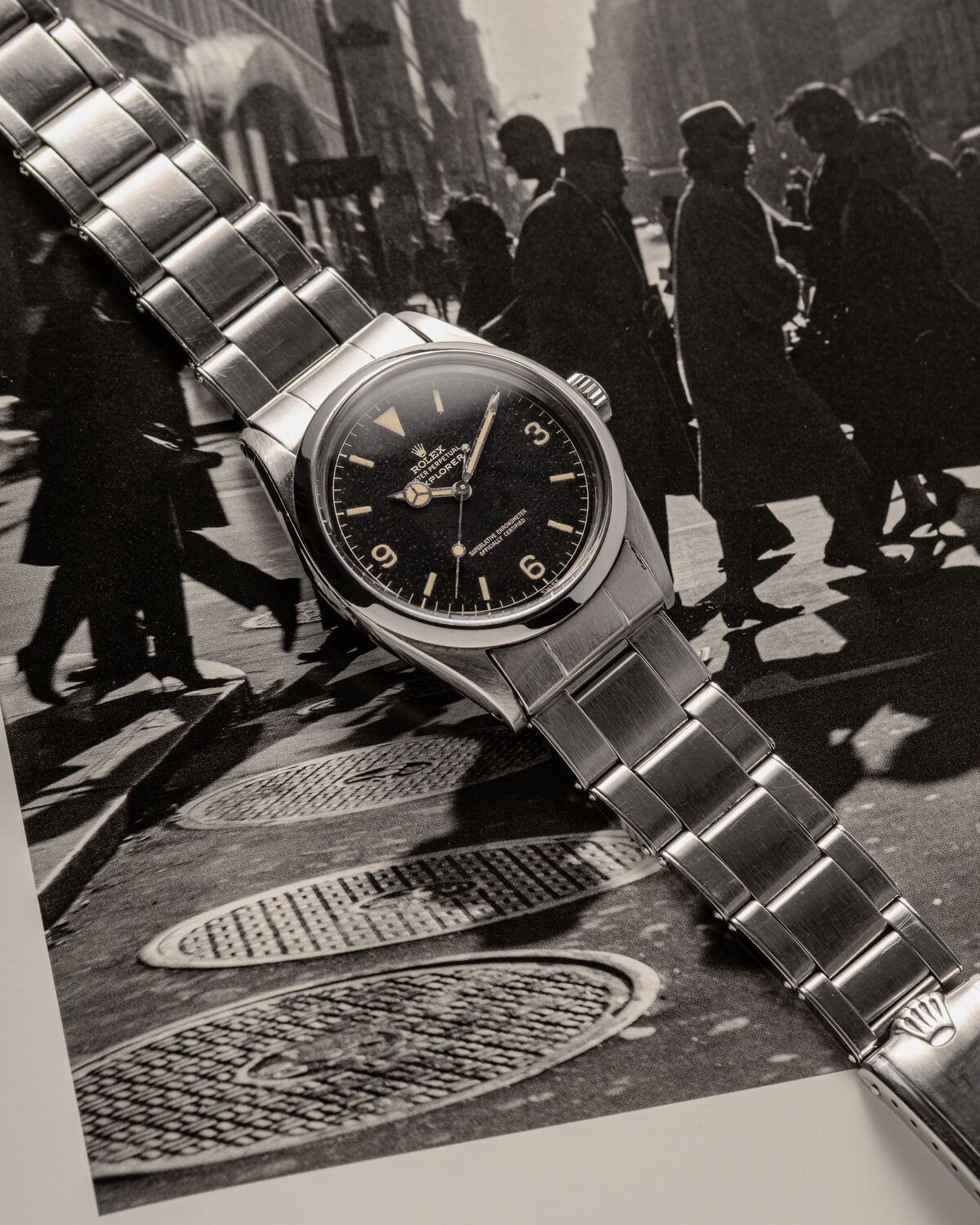
But what I particularly want to talk about with the example I am offering is the dial, the First generation on the reference 1016. Literally, the depth is what makes this watch so unique and interesting. Its originality and condition make it a real pleasure to wear.
Depth
In 1959, Rolex introduced the revised and now so recognizable Exploere I reference 1016, the successor to the 6610. The 36mm case with its black dial and 3, 6 and 9 numerals remained, but the watch was now fitted with a flatter and more modern calibre 1560. This was an automatic, chronometer-tested movement and one of the first calibres to be considered Superlative. These early calibres did not yet have a seconds-hacking system, so when the crown was pulled out, the seconds hand continued to run.
Although the movement had been designed to allow for a date mechanism, this was never used in the Explorer I. It would also have disturbed the very recognizable 3, 6 and 9 dial layout. Just like the Rolex Submariner 5513 from the same period, this is one of the things that gives the watch such a cool and balanced appearance. It gives the watch a sporty and almost technical look, a real tool watch.
The dial
Now it gets really interesting. The first series of dials, also referred to as Type I, were made using a very specific production technique. The so-called gilt dials were produced as follows.
Like all dials, the base is a thin brass disc with two feet that allow it to be attached to the movement. This disc was highly polished and then covered with a layer of gold plating. A glossy black top layer was then applied over the plate using a galvanic process, while the areas that needed to remain readable were left exposed.
This is why the name Rolex and the text underneath appear in the colour of the underlying gold-plated layer. If you look very closely, you can also see that the lettering sits slightly lower than the black surface of the dial itself. On the early versions, the minute track and sometimes also the model name and SCOC text were produced using the same technique.
Cave
What I find most remarkable is a very small detail that is rarely mentioned. As far as I know, this phenomenon can only be found on the very first Explorer dials, the MK “0” from 1959 and the MK I dials for 1960 till 1963.
At the locations where the luminous material of the hour markers, the 3, 6 and 9 and the triangular 12 o’clock marker is applied, the dial material itself has been recessed into these shapes. The luminous material was then applied into these caves, meaning that it sits almost at the same depth as the top surface of the galvanized black layer. Only a small amount of luminous paint protrudes above the surface.
This is therefore not a sandwich dial as used by Panerai. Instead, the base material of the dial has simply been recessed to accommodate the luminous material. It is an exceptionally unusual and unique detail.
When examining the dial and turning it through the light, this phenomenon is clearly visible. Especially around the 3 and 9, but also on the raised upper part of the 12 o’clock triangle, you can clearly see the difference in depth. It is these small and often overlooked details that make these first Rolex Explorers so interesting and desirable.
Condition
When valuing diamonds, the famous 4 C’s are used: Carat, Color, Clarity and Cut. When valuing vintage watches, you could almost use the 3 C’s: Condition, condition and condition. And this Rolex Explorer ticks every box.
The watch dates from the second quarter of 1960, marked “II 60” inside the case back, making it 66 years old. Apart from a few wrinkles here and there, it is genuinely in beautiful condition. The dial and hands are original. The case retains a beautiful shape and has clearly been well maintained. Naturally, it has been polished at some point, but certainly not over-polished.
The movement has also received Rolex service during its life. This can be seen from the later Rolex updates to the rotor and the automatic winding components. It currently shows an excellent power reserve and very accurate performance.
Bracelet
The bracelet is marked 6636 with end links 80. This is a 20mm riveted Oyster bracelet with flexible, expandable links. These bracelets are often seen on Rolex sports models from the mid-1960s through the 1970s. The clasp has the large protruding Rolex crown logo and is dated 2-70. This indicates that the bracelet dates from the second quarter of 1970. Whether the complete bracelet was replaced in 1970, or whether the clasp hinge was replaced at that time, is difficult to establish.
What is certain is that the bracelet retains its original construction and, more importantly, is in near-mint condition. It is tight, clean and the expandable mechanism works perfectly. I have rarely seen an expandable bracelet from this period in such condition.